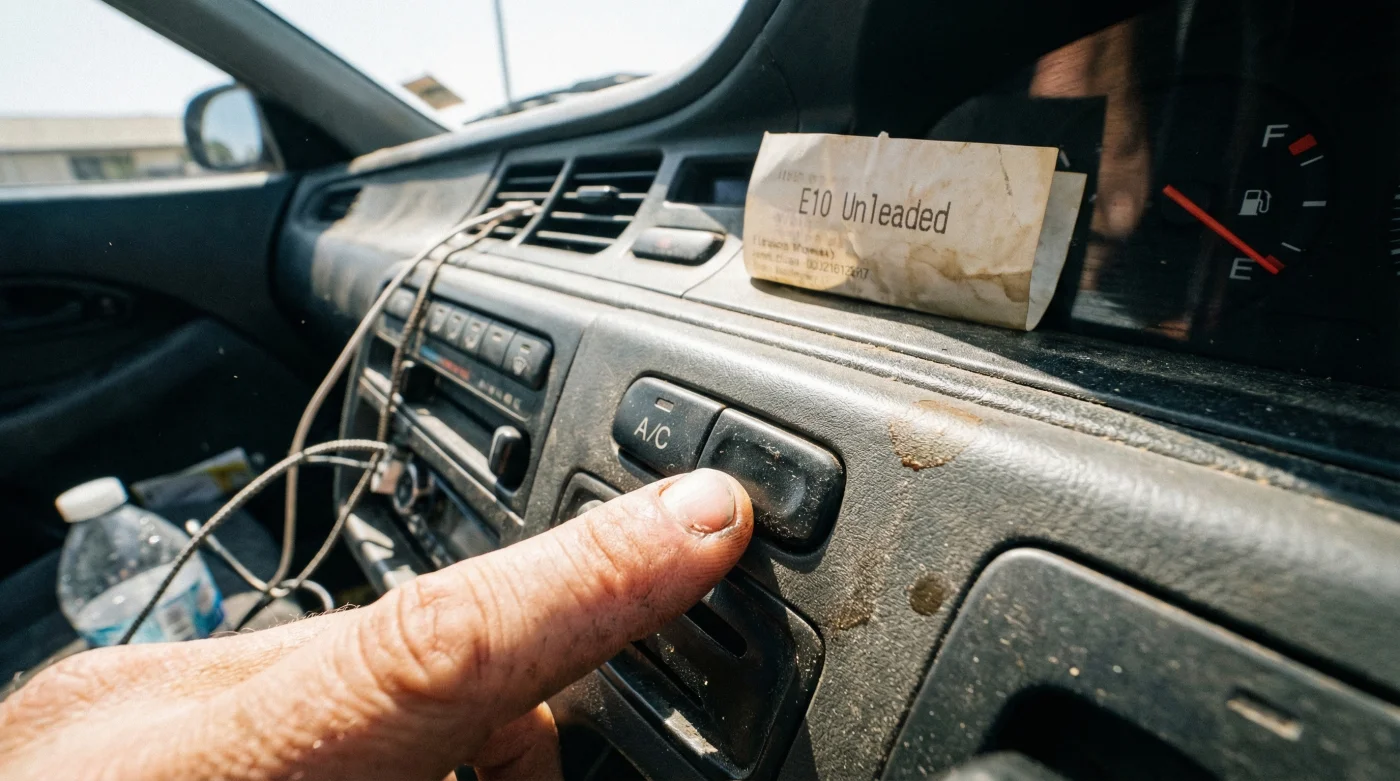
With forecourt prices continuously stretching household budgets, British drivers are constantly seeking ways to maximise the mileage of every drop of E10 Petrol. However, millions of motorists are unknowingly sabotaging their own fuel economy the moment they turn the ignition, courtesy of a deeply ingrained habit designed to maximise cabin comfort. The instinct to immediately regulate the interior temperature seems harmless, but it initiates a mechanical chain reaction that rapidly drains your fuel tank.
You might believe that keeping your vehicle tightly sealed and relying on the modern automatic climate setting is the most aerodynamic and efficient choice for your daily commute. Yet, automotive engineers warn that engaging this specific dashboard button fundamentally alters your engine’s workload, forcing it to guzzle the slightly less energy-dense modern fuel at an alarming rate. Unlocking the secret to why this happens could save you hundreds of pounds sterling at the petrol station this year.
The Mechanical Parasitic Drain on Modern Engines
When you press the air conditioning or dedicated climate control button, you are not simply turning on a fan. You are engaging the AC compressor, a heavy-duty mechanical pump driven directly by the engine’s crankshaft via the serpentine belt. This process creates a significant parasitic load. In older vehicles, or those running less efficient climate systems, this compressor demands constant kinetic energy to compress the refrigerant gas, effectively stealing horsepower directly from your wheels. To compensate for this sudden loss of power and prevent stalling, the engine management system injects more fuel into the combustion chamber.
This mechanical theft becomes particularly pronounced during low-speed urban driving. When you are crawling through city traffic or navigating congested roundabouts at under 45 miles per hour, aerodynamic drag is virtually non-existent. In these scenarios, the mechanical load of the compressor burns drastically more fuel than simply rolling down the windows. Driving with the windows down at low speeds allows natural ventilation without forcing the engine to drag the dead weight of an active climate compressor.
Driver Impact and Benefit Analysis
| Driver Environment | Climate Control Habit | Impact on E10 Petrol Consumption | The Efficient Alternative |
|---|---|---|---|
| Urban Commute (Under 45 mph) | Full AC / Climate engaged | Up to 10% reduction in overall MPG | Windows rolled down 3-4 inches |
| Motorway Cruising (Over 60 mph) | Windows fully open | Massive aerodynamic drag (drains fuel) | AC set to low flow / Eco-mode |
| Short Winter Journeys | Heated screens + AC max defrost | Extreme alternator and compressor load | Manual scrape and moderate AC usage |
Understanding this mechanical parasitic draw is only half the battle; the real shock comes from how modern pump fuel reacts to this stress.
Why E10 Amplifies the Fuel Drain
- Put a scrape of tongue-cleaning paste on your brush for 24-hour freshness
- The ‘1910’ secret; why Steven Knight is already writing a Peaky Blinders prequel
- I tried the 2026 AI-guided brush and the pressure alert is vital
- The ‘Structural Match’ reason Kate’s burgundy belt exactly mirrored Prince William’s Armani blazer
- Open the unredacted 147-page dossier to see the warnings Starmer ignored
When you activate high-demand dashboard features like the air conditioning compressor or rapid defrost systems, the engine suddenly requires a surge of torque. Because the fuel in the tank is less energy-dense, the electronic fuel injectors must spray a physically larger volume of E10 Petrol into the cylinders to meet the exact same power demand. This compounding effect—a high mechanical load paired with a lower-energy fuel—creates a perfect storm for rapid fuel depletion. Experts advise that ignoring this chemical reality can reduce your range by up to 30 miles per tank.
Scientific Fuel and Energy Metrics
| Fuel Grade | Bioethanol Content | Energy Density (Megajoules per Litre) | Engine Compensation under AC Load |
|---|---|---|---|
| Standard Unleaded E5 (Legacy) | Up to 5% | Approx. 33.7 MJ/L | Moderate fuel injection increase |
| Standard E10 Petrol (Current) | Up to 10% | Approx. 32.5 MJ/L (Lower) | Aggressive fuel injection volume increase |
| Super Unleaded (E5 Premium) | Up to 5% | Approx. 33.7+ MJ/L | Stable torque response, minor mpg drop |
To counteract this chemical reality, drivers must learn to diagnose the subtle signs of fuel wastage before the tank runs dry.
Diagnosing Your Dashboard’s Hidden Fuel Thieves
Identifying exactly when your comfort settings are robbing your wallet requires a keen ear and a basic understanding of vehicle thermodynamics. Many modern cars attempt to mask the heavy lifting happening beneath the bonnet, but your vehicle will always exhibit subtle symptoms when it is struggling under a high parasitic load. By matching these symptoms to their root causes, you can actively alter your driving habits.
The Symptom = Cause Diagnostic List
- Symptom: A sudden, brief drop in engine RPM or a faint ‘click’ sound from behind the dashboard when idling at traffic lights. = Cause: The electromagnetic clutch of the AC compressor engaging, instantly pulling torque away from the drivetrain and forcing the engine to burn more E10 Petrol to maintain idle speed.
- Symptom: Sluggish acceleration pulling away from junctions on cold mornings. = Cause: Concurrent use of heated windscreens, heated seats, and the climate fan. The alternator is under maximum strain, generating massive magnetic resistance on the engine block.
- Symptom: Noticeably poor miles per gallon (MPG) during short supermarket runs. = Cause: The climate system is trying to rapidly cool or heat a heat-soaked or freezing cabin in under 10 minutes, forcing the compressor to run at maximum output for the entire journey without reaching a stable, efficient thermostat threshold.
Mastering these diagnostics paves the way for a highly strategic approach to your vehicle’s climate settings.
The Strategic Climate Control Protocol
You do not need to suffer in sweltering heat or freezing cold to preserve your fuel. The key lies in strategic, precise dosing of your vehicle’s climate features. Automotive technicians recommend treating your dashboard buttons with calculated precision rather than leaving them on automatic default. This is where actionable adjustments make a tangible difference at the petrol pump.
For maximum efficiency, apply these specific ‘dosing’ metrics to your daily drive: Set your digital climate control to exactly 21 Degrees Celsius; this is universally recognised as the optimal temperature where the system exerts the least effort to maintain equilibrium. When clearing a foggy windscreen, run the AC button for a strict maximum of 5 minutes to dehumidify the glass, then immediately switch back to standard fan circulation. If the cabin is dangerously hot in summer, open all doors for 60 seconds before departing to purge the trapped thermal mass, rather than forcing the air conditioning to cool superheated air.
The Climate Optimisation Progression Guide
| Dashboard Feature | What to Look For (Efficiency) | What to Avoid (The Fuel Drain) |
|---|---|---|
| Air Conditioning Button | Engaging only above 45 mph; using ‘Eco’ mode if available to cycle the compressor. | Leaving it illuminated constantly 365 days a year out of sheer habit. |
| Recirculation Button | Activating once the cabin reaches target temperature to cool already-chilled air. | Using it constantly on damp days, which causes fogging and forces AC use. |
| Heated Windscreens | Using the timer function; deactivating the moment the frost turns to water. | Relying on the electronic heater to melt thick ice instead of a manual scraper. |
By implementing these highly specific protocols and understanding the lower energy density of modern forecourt fuels, British drivers can successfully reclaim their lost mileage and outsmart the hidden costs of modern motoring.
Read More